The Jammu and Kashmir Police have dismantled a major narcotics network with interstate and cross-border links, arresting the most-wanted drug kingpin Gulzar Ahmad alias Lau Gujjar and several associates.
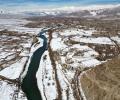
India has asserted that the Indus Waters Treaty with Pakistan will remain in "abeyance" until Islamabad "credibly and irrevocably" abjures support to cross-border terrorism. External Affairs Ministry spokesperson Randhir Jaiswal said that any bilateral talks with Islamabad will only be on vacation of illegally occupied territories of Kashmir by Pakistan. He also said that India is open to discussing the handing over of terrorists whose list was provided to Pakistan some years ago. India on April 23 announced a raft of punitive measures against Pakistan including suspension of the Indus Waters Treaty after the Pahalgam terror attack that killed 26 civilians.

Pakistani security forces killed a suspected militant driving an explosive-laden vehicle towards a check post in Khyber Pakhtunkhwa province, resulting in an explosion that injured seven civilians.

The government stated that Operation Sindoor was launched in response to a 'barbaric' attack by 'Pakistan-sponsored terrorists,' focusing on dismantling terror infrastructure and neutralizing terrorists likely to be sent across to India.

Delhi Police have arrested a suspected Lashkar-e-Taiba (LeT) handler, Shabir Ahmed Lone, from the Ghazipur area. He is believed to have links with Pakistan's ISI and was allegedly involved in a terror module planning attacks in India.
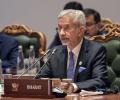
India has expressed serious concerns about the West Asia crisis and its potential impact on energy supplies and maritime stability, urging BRICS nations to find practical solutions to geopolitical challenges and unilateral sanctions.

India shouldn't play Pakistan even at ICC events till terrorism ends: Gambhir
At least 15 security officials were killed and several injured in a suicide attack and ambush at a police post in Pakistan's Khyber Pakhtunkhwa province.
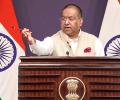
External affairs ministry spokesperson Randhir Jaiswal said India will keep the IWT in abeyance until Pakistan "credibly and irrevocably" abjures its support for cross-border terrorism.
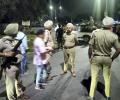
Two men, believed to be the main perpetrators of the blast outside the Punjab BJP headquarters, have been arrested in Haryana. This follows the earlier arrest of five individuals linked to a Pakistan ISI-backed module.

The Army Chief said India's political brass has the will to strengthen the country's deterrence capabilities.
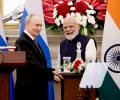
India and Russia have called for an uncompromising global fight against terrorism without hidden agendas and double standards. Prime Minister Narendra Modi asserted that the menace is a direct attack on the values of humanity.
At least 15 security officials were killed and several were injured in a suicide attack and ambush at a police post in Pakistan's Khyber Pakhtunkhwa province.

India has strongly condemned Pakistan's airstrikes on Afghanistan, calling them a flagrant violation of international law and hypocritical given the civilian casualties during Ramzan.

Decisive action has replaced dossiers and the new India can go to any extent to uproot terrorism, Defence Minister Rajnath Singh said on Monday while stating that Operation Sindoor was on pause as the armed forces had achieved the desired objectives.
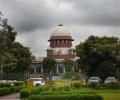
The Supreme Court has raised concerns about the low conviction rates under the Unlawful Activities (Prevention) Act (UAPA), noting that over 90 per cent of trials result in acquittals. The observations were made while granting bail to an accused in a narco-terrorism case.
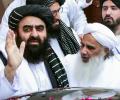
The scheduled visit of Afghanistan Foreign Minister Amir Khan Muttaqi to Agra has been cancelled. The cancellation was confirmed by officials, though no reason was provided. Muttaqi is currently on a six-day trip to India, the first such visit by a senior Taliban minister in four years.
Jammu and Kashmir Police chief Nalin Prabhat issued a stern warning to Pakistan-based gangster Shahzad Bhatti for 'pumping narcotics' into India, vowing to dismantle his network.

Pakistan confirms that talks with the Afghan Taliban to address cross-border terrorism have failed, citing a lack of commitment from Kabul to control militancy. Pakistan accuses the Taliban of supporting anti-Pakistan terrorists and blames India for the failure of the talks.

The BRICS foreign ministers' meeting in New Delhi concluded without a joint statement due to disagreements over the West Asia conflict, with Iran blaming the UAE for the lack of consensus. India, as the host, issued a chair's statement highlighting the differing views.
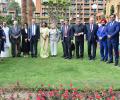
All-party parliamentary delegations on Monday met with the leaders of several countries and highlighted India's resolve to combat terrorism, which they stressed must be eradicated in the interests of all humanity.

Pakistan launched a military operation targeting terrorist hideouts in Afghanistan following a series of attacks, including a suicide bombing that killed Pakistani soldiers. The action comes after repeated calls for the Afghan Taliban to prevent terrorists from using Afghan soil to launch attacks against Pakistan.

India stressed that it is even more extraordinary for a country with a history of rigged elections to talk about political choices, that too in a democracy.
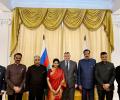
The Kanimozhi Karunanidhi-led delegation is visiting five European nations to garner support for India's campaign against cross-border terrorism.
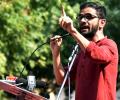
The Supreme Court has reaffirmed that bail is the general rule, even in cases registered under the Unlawful Activities (Prevention) Act (UAPA), while granting bail to an accused in a narco-terror case.
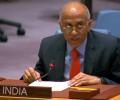
India's Permanent Representative to the UN Ambassador Parvathaneni Harish said that the Indian sub-continent offers a "stark contrast" in terms of progress, prosperity and development models.

Delhi Police's Special Cell has dismantled an inter-state terror, arms, and espionage module allegedly supported by Pakistani handlers and the ISI, revealing a covert surveillance network near sensitive military locations.
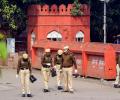
'Rather than deploying Pakistani nationals or using identifiable cross-border materials, the ISI sought to radicalise and recruit local Indian youth, including well-educated professionals such as doctors.'

An 11-year-old boy's simple act of serving Indian soldiers during Operation Sindoor has become an inspiring story. Shavan Singh voluntarily provided tea, water, and lassi to Army jawans deployed in his village along the Indo-Pak border, earning him national recognition and the title of 'Youngest Civilian Warrior'.

In an address at a security conclave of the Shanghai Cooperation Organisation in the Kazakh capital, he also underlined the need for holding accountable the sponsors, financiers and facilitators of terrorism, in remarks that came amid Pakistan's continuing support to various terror groups.

Modi, who visited Cyprus in the first leg of his three-nation visit, reiterated India's support for Cyprus's unity and for a peaceful resolution of the Cyprus Question based on UN Security Council resolutions, international law, and the EU Acquis.
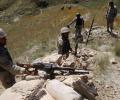
Pakistani and Afghan forces exchanged fire, testing the fragile peace between the two sides as officials from both countries held talks in Turkiye to find a lasting solution to cross-border militancy.

The Union government has informed the Bombay High Court that Agniveers are not "similarly situated" as regular soldiers and hence, cannot claim parity in pensionary benefits for their next of kin in the event of death in action.
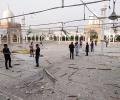
"Similarly, 60 launchpads are working in the other depth areas away from the border," BSF DIG Vikram Kunwar told reporters in Jammu.
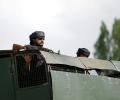
'Whatever we do, the purpose will be to re-establish deterrence.'

Sources said the party has picked up some other leaders who will represent it during the 16-hour debate.

A devastating airstrike on a Kabul drug rehabilitation centre has killed hundreds, escalating tensions between Afghanistan and Pakistan and prompting international calls for de-escalation and investigation.

External Affairs Minister S Jaishankar addresses Parliament on Operation Sindoor, denying any US trade linkage and highlighting Pakistan's request for a ceasefire through the DGMO channel.

The Enforcement Directorate (ED) reports a decline in traditional financial crimes due to sustained investigative actions and government initiatives, while highlighting emerging challenges like cryptocurrency fraud and terror financing.

The Dhurandhar movies will undoubtedly shape the minds of the audience much more than news reports, court investigations, books and documentaries. But it is worth remembering that Pakistan's irridentist claims against India's national security have succeeded due to strategic planning, diplomacy, and the unsung heroines and heroes across government agencies, not due to a single maverick leader, points out Shweta Desai.But it is worth to remember that Pakistan's irredentist claims against India's national security have succeeded due to strategic planning, diplomacy, and the unsung heroines and heroes across government agencies -- not a single maverick, points out Shweta Desai.
